What is a Double Diamond? A Simple Guide to the Design Process
Feb 16, 2026
·
3 min read
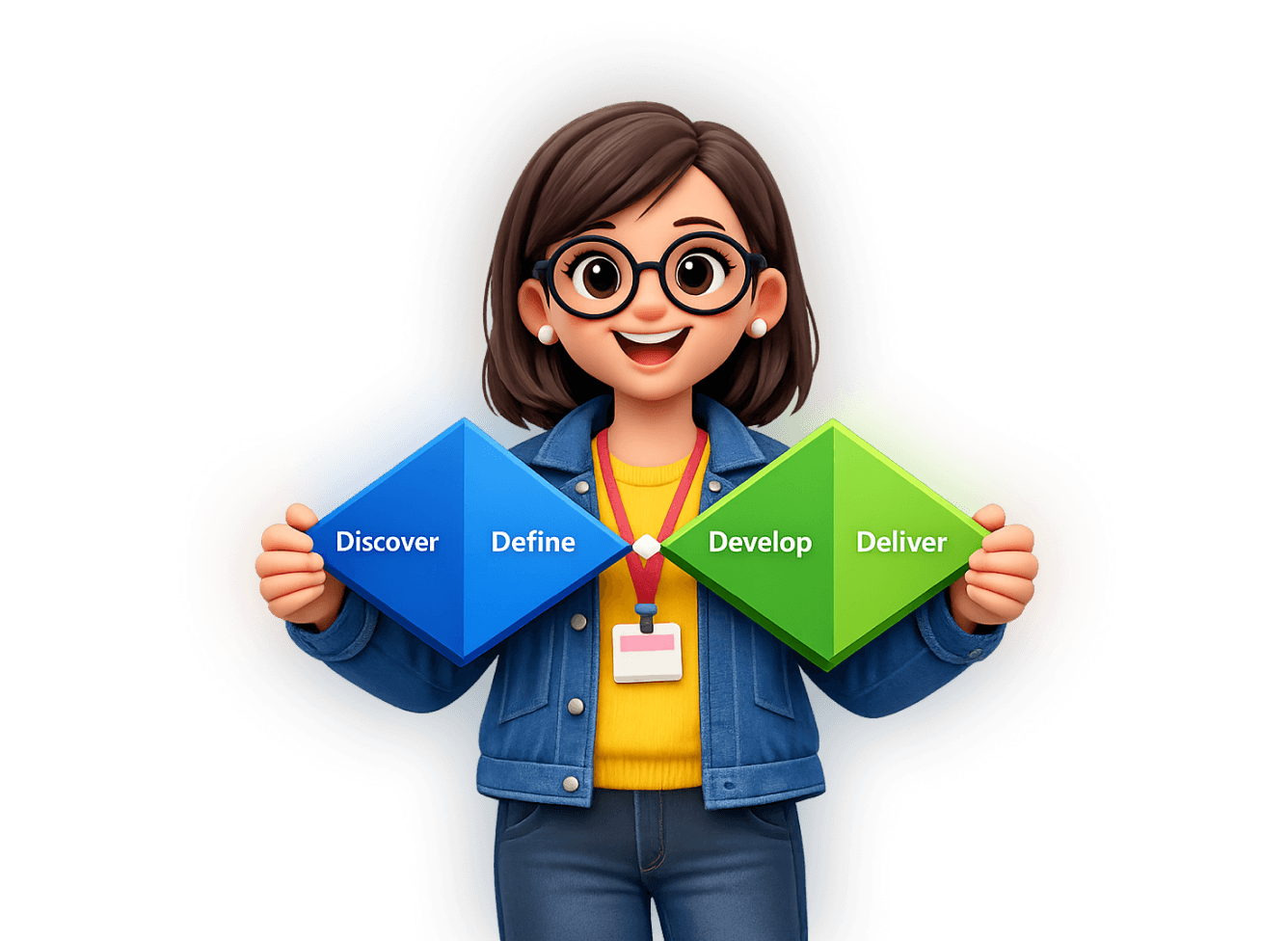
The Double Diamond is a design process model that helps teams solve problems creatively and effectively by dividing the journey into four clear phases: Discover, Define, Develop, and Deliver.
If you’ve ever wondered how designers move from a messy problem to a polished solution, the Double Diamond is one of the most popular answers. Created by the UK Design Council in 2005, this framework has become a foundation in UX design, product design, and innovation strategy around the world.
Let’s break it down in a simple and practical way.
Why is it called the Double Diamond?
The name comes from the shape of the process. Imagine two diamonds placed side by side:
The first diamond focuses on understanding the problem.
The second diamond focuses on creating the solution.
Each diamond has two parts:
First, you diverge (expand your thinking and explore widely).
Then, you converge (narrow down and focus on what matters most).
This balance between exploring and focusing is what makes the Double Diamond so powerful.
The Four Phases of the Double Diamond
1. Discover
This is the research phase.
Instead of jumping straight into solutions, you explore the problem deeply. You collect insights, talk to users, observe behaviors, and gather as much information as possible.
Key activities:
User interviews
Surveys
Market research
Competitor analysis
Observations
The goal here is simple: understand the real problem, not just the obvious one.
Many projects fail because teams solve the wrong problem. The Discover phase helps to prevent that.
2. Define
After collecting insights, it’s time to make sense of everything.
In this phase, you:
Organize research findings
Identify patterns
Clarify user needs
Define a clear problem statement
This is where you turn messy information into a focused direction.
3. Develop
Once the problem is clearly defined, it’s time to explore solutions.
This is the creative stage. You brainstorm, sketch, prototype, and test different ideas.
Key activities:
Brainstorming sessions
Wireframing
Prototyping
User testing
The goal is to generate multiple ideas instead of settling for the first one. Great design often comes from testing many possibilities before choosing the best.
4. Deliver
Finally, you refine and launch the best solution.
In this stage, you:
Test prototypes
Gather feedback
Improve the design
Finalize and launch
It’s about polishing the solution and making sure it truly solves the defined problem.
But here’s something important: the Double Diamond is not always linear. Sometimes, testing reveals new insights, and you may go back to earlier stages. That flexibility is part of good design thinking.
Why is the Double Diamond important?
The Double Diamond helps teams avoid two common mistakes:
Solving problems too quickly without proper research
Falling in love with one idea too early
It encourages:
Structured creativity
User-centered thinking
Clear communication
Better collaboration between designers, developers, and stakeholders
Whether you’re designing an app, a website, a product, or even a service, this framework gives you a roadmap.
Is the Double Diamond only for designers?
Not at all.
Although it started in the design world, the Double Diamond can be used in:
Business strategy
Marketing campaigns
Product development
Startup planning
Innovation workshops
Anytime you need to solve a problem creatively and thoughtfully, this model can help.
Final thoughts
So, what is a Double Diamond? It’s a structured yet flexible design framework that guides teams from understanding a problem deeply to delivering a tested and refined solution through two cycles of exploration and focus.
If you’re serious about improving your design thinking skills, mastering the Double Diamond is a great step forward. It teaches you patience, clarity, and the importance of user-centered design.
If you aren't following us on Instagram already, you're seriously missing out! Become a part of our ever-growing community and learn something new from the field of product design every. single. day.
Happy designing! 🥳
andrija & supercharge design team

If you aren't following us on Instagram already, you're seriously missing out! Become a part of our ever-growing community and learn something new from the field of product design every. single. day.
Happy designing! 🥳
andrija & supercharge design team
Related blog posts
You might like the following
You might like the following


LIMITED-TIME OFFER
Get 12 premium members-only video lessons for free
Just tell us where to send them
You can unsubscribe at any time—no strings attached
LIMITED-TIME OFFER
Get 12 premium members-only video lessons for free
Just tell us where to send them
You can unsubscribe at any time—no strings attached